How Dynamics 365 Partners are Solving the UAE’s Complex Multi-Entity Compliance
This is where the expertise of Microsoft Dynamics 365 becomes invaluable. They aren't just installing software; they are re-architecting how businesses navigate a "hard-deadline" environment where manual workarounds are now a major financial risk.
The 2026 Compliance Landscape: A New Standard of Rigor
The UAE Federal Tax Authority (FTA) has made it clear: the era of indefinite VAT credits and flexible reporting is over. As of January 1, 2026, a strict five-year cap on carrying forward excess input tax has taken effect. For multi-entity groups, this creates a massive data-reconciliation challenge. If your entities aren't perfectly aligned, you risk losing millions in recoverable tax simply because the clock ran out.
Furthermore, the introduction of the 4-Corner e-invoicing model means that by early 2027, every B2B and B2G transaction must be a structured XML file transmitted via an Accredited Service Provider (ASP). The complexity of managing these real-time requirements across dozens of subsidiaries is precisely why enterprises are turning to specialized in Dynamics 365.
1. Unifying the "Multi-Entity Maze"
Operating a conglomerate in the UAE often involves a mix of Mainland, Mainland-Free Zone, and Designated Free Zone entities. Each has its own tax treatment. A partner helps solve this through:
Unified Chart of Accounts: Standardizing financial data so that intercompany transactions are eliminated automatically, preventing the "double-counting" that often triggers FTA audits.
Localized Tax Engines: Configuring Dynamics 365 Finance to handle the specific nuances of UAE VAT and the 9% Corporate Tax, ensuring that "Tax Groups" are reporting as a single unit while maintaining individual entity audit trails.
Gratuity and Payroll Governance: In 2026, workforce liabilities are being scrutinized more than ever. Partners implement modules that automate End of Service Benefits (EoSB) and integrate directly with the Wages Protection System (WPS).
2. Leveraging Microsoft Power Platform Services for "Gap-Filling"
Standard ERP systems are powerful, but the UAE’s unique local requirements often require more agility. This is where Microsoft Power Platform services play a critical role. Instead of expensive, "heavy" customizations to the core ERP, partners use low-code solutions to bridge the gaps:
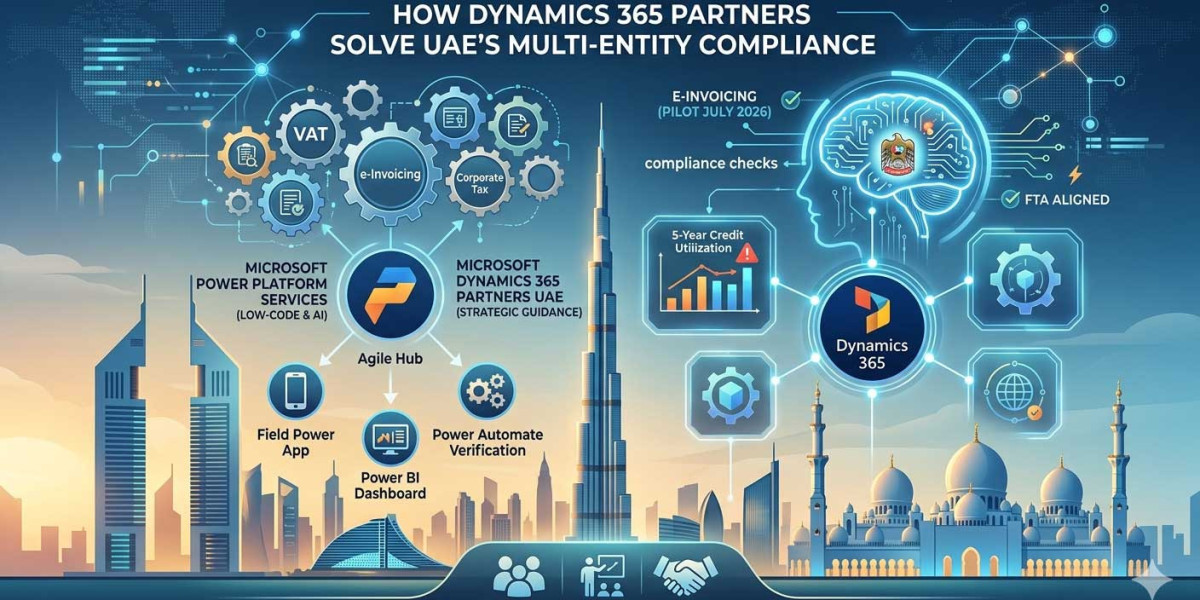
Real-Time Compliance Dashboards (Power BI)
With the new five-year credit expiration rule, CFOs need to know exactly which credits are at risk. Partners use Microsoft Power Platform services to build Power BI dashboards that flag expiring tax credits and monitor e-invoicing success rates across all entities in real-time.
Automated Supplier Verification (Power Automate)
Under the new "Knew or Should Have Known" standard, the FTA can deny your input tax if your supplier isn't properly registered. Partners use automation to cross-reference TRNs (Tax Registration Numbers) against the FTA database before a payment is ever released.
Mobile-Ready Field Reporting (Power Apps)
For sectors like construction or retail, capturing project-based expenses on-site and ensuring they meet tax-compliant documentation standards is vital. Custom Power Apps allow employees to upload documents that are instantly validated for compliance.
3. The E-Invoicing Readiness Strategy
The July 2026 pilot phase for e-invoicing is the "litmus test" for UAE businesses. Microsoft Dynamics 365 partners UAE are currently leading "Readiness Assessments" to ensure that:
ERP Data Integrity: Every field required by the Ministry of Finance Data Dictionary (UBL or PINT-AE standards) is mapped correctly within the system.
ASP Integration: Dynamics 365 is seamlessly connected to an Accredited Service Provider to ensure that XML invoices are signed, transmitted, and stored in accordance with the Tax Procedures Law.
System Resilience: Businesses must report system failures to the FTA within two days. Partners implement monitoring tools that alert IT teams the moment a transmission fails, avoiding the AED 1,000 per day penalty.
The Human Element: Training and Change Management
Technology is only half the battle. A truly effective partner understands that human error is still the biggest cause of compliance failure. They provide tailored training for local teams, ensuring they understand the shift from "PDF-based" invoicing to "Real-time Data Transmission."
By combining the industrial-strength capabilities of Dynamics 365 with the agile, automated power of Microsoft Power Platform services, UAE businesses are doing more than just staying legal—they are gaining a level of operational clarity that was previously impossible.
Conclusion
In the UAE’s "Digital First" tax era, compliance is no longer a yearly event—it’s a heartbeat. Working with the right Microsoft Dynamics 365 ensures that your multi-entity structure is an asset rather than a liability. By automating the mundane and providing high-level visibility, these partners are helping UAE firms build a foundation for growth that is audit-proof and future-ready.