
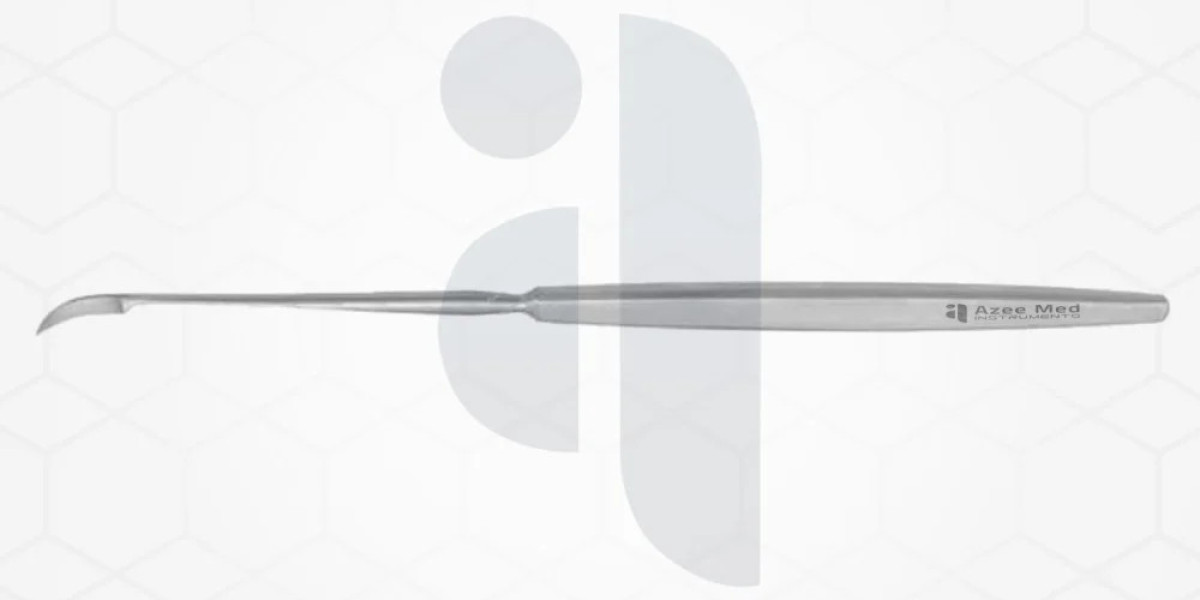
In the complex domain of reconstructive surgery, achieving precise anatomical repositioning requires instrumentation that balances mechanical leverage with delicate tissue handling. The midface and maxillary regions present unique structural challenges due to dense bone attachments and the proximity of vital sensory pathways. To manage these complexities, surgeons rely on specialized hand-held retractors engineered to provide controlled directional force. The tessier mobilizer stands out as a foundational tool designed specifically to manipulate, advance, and stabilize osseous structures during advanced midface advancements and corrective surgeries. By integrating an innovative curved architecture with specialized surface textures, this tool empowers practitioners to manage challenging bone fractures and congenital anomalies with heightened accuracy.
Azeemed Instruments is dedicated to providing high-quality surgical tools that meet the needs of professionals. Our manufacturing processes focus on absolute dimensional accuracy, exceptional tactile feedback, and strict adherence to international medical standards. We understand that in craniofacial reconstruction, the performance of an instrument directly influences procedural fluency and patient recovery timelines.

The Biomechanics of Maxillary Advancement
Realigning the maxilla requires a deliberate application of force to break residual bony bridges following an osteotomy. The design of the tessier mobilizer addresses this requirement by acting as a rigid lever system that fits seamlessly within the palatal arch. Featuring deep structural curves along its shaft, the instrument circumvents surrounding soft tissues without exerting excessive localized pressure that could cause ischemic necrosis.
During bilateral advancements, operating room teams frequently utilize these instruments in pairs, allowing for a symmetrical forward projection of the upper jaw skeleton. The dual-curve profile ensures that the forces applied remain parallel to the mid-sagittal plane, preventing unintended rotational deviation of the midface complex. This structural rigidity is crucial for overcoming resistance from the pterygoid buttress and the nasal septum, enabling smooth down-fracturing and forward transposition.
Engineering Precision in ENT Surgical Instruments
In the broader context of ent surgical instruments, tools must provide clear visualization within narrow, deep surgical pathways. Maxillofacial and upper airway reconstructions demand specialized retractors that provide maximum field exposure without obstructing the surgical site. The tessier mobilizer fulfills this dual purpose by acting as a highly efficient tissue separator and bone lever, making it a staple across both otolaryngology and oral-maxillofacial surgery disciplines. Its smooth satin finish is engineered to neutralize glare under intense operating room lighting, preserving depth perception when working near critical structures like the infraorbital nerve and palatine arteries.
Structural Elements of the Tessier Mobilizer
The clinical efficacy of the tessier mobilizer stems directly from its specific structural elements, each tailored to handle rigid bone segments while protecting adjacent mucosa. The working tip features a distinct rectangular, serrated profile designed to engage the hard palate securely, preventing slippage during heavy traction. This secure interface distributes the mechanical workload across the dense palatal shelf rather than puncturing or bruising delicate soft tissues.
At the opposite end, the instrument features an ergonomic hollow handle equipped with a prominent terminal hook. This hollow construction significantly reduces the overall weight of the device, mitigating user hand fatigue during lengthy reconstructive workflows. The terminal hook provides an additional secure anchor point for the surgeon’s fingers, allowing for steady, sustained pulling force without sacrificing tactile awareness of bone movement.
Clinical Workflows in Midface Osteotomies
The operational sequence for manipulating midface structures involves rigorous steps where instrument reliability cannot be compromised. The tessier mobilizer is introduced immediately following the completion of cortical bone incisions, typically during a Le Fort I osteotomy sequence. Once the lateral, septal, and pterygoid walls are split, the instrument is inserted to initiate the downward fracture and subsequent sagittal advancement.
Surgeons select matching left and right configurations of the device to engage both palatal shelves simultaneously. By applying a coordinated downward and forward vector, the midface unit is safely detached from its cranial attachments. The broad surface area of the rectangular tips minimizes localized stress concentrations, drastically reducing the incidence of palatal bone fragmentation or micro-fractures during initial mobilization.
Maintenance and Material Longevity Standards
Because these instruments are subjected to significant mechanical stress and regular chemical exposure during reprocessing, material composition is vital to long-term performance. Our instruments are forged from premium medical-grade stainless steel alloys that provide high tensile strength alongside excellent corrosion resistance. This alloy composition ensures that the thin, curved shaft resists bending or metal fatigue even when encountering high resistance from dense bone structures.
To maintain perfect clinical safety, the entire assembly is designed without deep crevices, allowing for complete fluid clearance during ultrasonic cleaning and thermal disinfection. The instrument withstands repeated high-temperature steam sterilization cycles without degradation of its satin finish or loss of serration sharpness. This durability guarantees consistent mechanical feedback and predictable performance across thousands of surgical interventions.