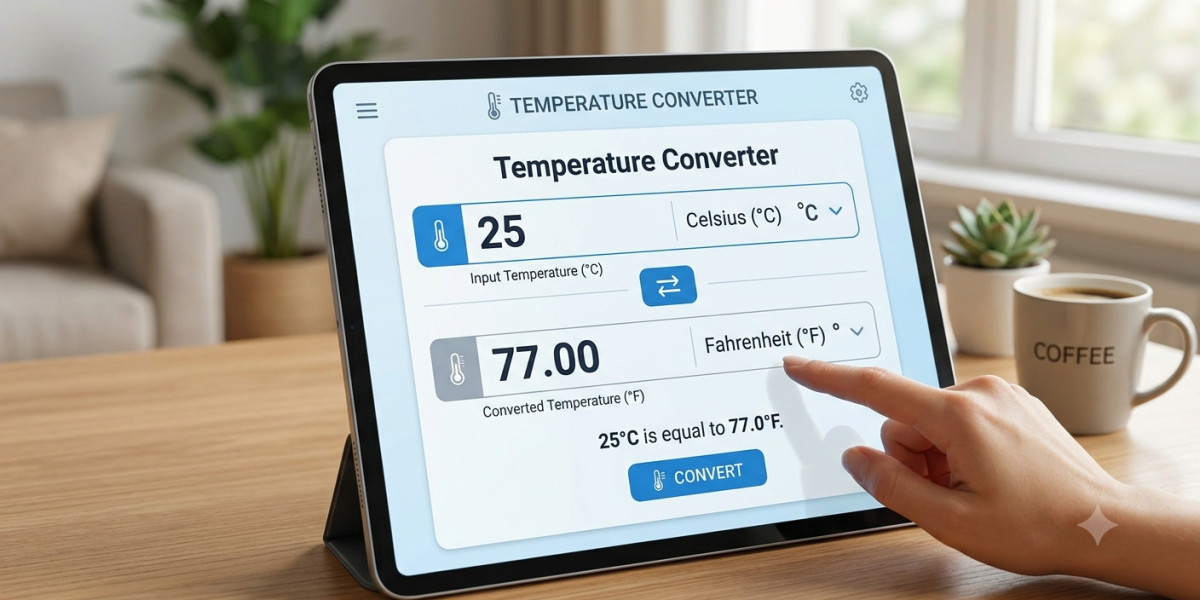
Temperature is one of the most frequently measured quantities in daily life, science, cooking, medicine, engineering, and weather forecasting. Yet the world uses multiple temperature scales, and converting between them involves formulas that are easy to get wrong under pressure. Whether you are reading a recipe from another country, interpreting a weather forecast, or working on a scientific calculation, having a fast and accurate tool at your side makes a real difference. That is why platforms like multiconverters.net are so valuable, offering essential conversion tools in one place so you never have to fumble through a formula when you need a quick answer.
What Is a Temperature Converter?
A Temperature Converter is a tool that takes a temperature value in one scale and converts it accurately into one or more other scales. You enter the temperature, select the source unit, and the converter instantly displays the equivalent in all other supported scales.
A Temperature Converter handles all major temperature scales including Celsius, Fahrenheit, Kelvin, and Rankine, covering everything from everyday weather readings to absolute zero in thermodynamics.
The Major Temperature Scales
Celsius (C)
Celsius is the most widely used temperature scale in the world. It is part of the metric system and is the standard in science, medicine, and daily life in almost every country. The Celsius scale sets the freezing point of water at 0 degrees and the boiling point at 100 degrees at standard atmospheric pressure.
Fahrenheit (F)
Fahrenheit is primarily used in the United States and a handful of other territories. On this scale, water freezes at 32 degrees and boils at 212 degrees. Body temperature is approximately 98.6 degrees Fahrenheit. The Fahrenheit scale uses smaller degree intervals than Celsius, which is why its numbers appear larger for the same physical temperature.
Kelvin (K)
Kelvin is the SI base unit of temperature used in science and engineering. It starts at absolute zero, the theoretical point at which all molecular motion stops, which is 0 K or minus 273.15 degrees Celsius. Kelvin uses the same degree size as Celsius but starts from a different zero point. Kelvin values are never written with a degree symbol.
Rankine (R)
Rankine is used in some engineering fields, particularly in the United States, for thermodynamic calculations. Like Kelvin, it starts at absolute zero, but it uses the same degree size as Fahrenheit. 0 Rankine equals 0 Kelvin equals minus 459.67 degrees Fahrenheit.
Temperature Scale Comparison at Key Reference Points
| Reference Point | Celsius | Fahrenheit | Kelvin | Rankine |
|---|---|---|---|---|
| Absolute zero | -273.15 | -459.67 | 0 | 0 |
| Freezing point of water | 0 | 32 | 273.15 | 491.67 |
| Room temperature | 20 | 68 | 293.15 | 527.67 |
| Body temperature | 37 | 98.6 | 310.15 | 558.27 |
| Boiling point of water | 100 | 212 | 373.15 | 671.67 |
| Oven temperature (moderate) | 180 | 356 | 453.15 | 815.67 |
Temperature Conversion Formulas
Celsius to Fahrenheit
F = (C x 9/5) + 32
Example: 25 degrees Celsius = (25 x 9/5) + 32 = 45 + 32 = 77 degrees Fahrenheit
Fahrenheit to Celsius
C = (F - 32) x 5/9
Example: 98.6 degrees Fahrenheit = (98.6 - 32) x 5/9 = 66.6 x 5/9 = 37 degrees Celsius
Celsius to Kelvin
K = C + 273.15
Example: 100 degrees Celsius = 100 + 273.15 = 373.15 Kelvin
Kelvin to Celsius
C = K - 273.15
Example: 300 Kelvin = 300 - 273.15 = 26.85 degrees Celsius
Fahrenheit to Kelvin
K = (F - 32) x 5/9 + 273.15
Kelvin to Fahrenheit
F = (K - 273.15) x 9/5 + 32
Celsius to Rankine
R = (C + 273.15) x 9/5
Fahrenheit to Rankine
R = F + 459.67
All Conversion Formulas at a Glance
| From | To | Formula |
|---|---|---|
| Celsius | Fahrenheit | (C x 9/5) + 32 |
| Celsius | Kelvin | C + 273.15 |
| Celsius | Rankine | (C + 273.15) x 9/5 |
| Fahrenheit | Celsius | (F - 32) x 5/9 |
| Fahrenheit | Kelvin | (F - 32) x 5/9 + 273.15 |
| Fahrenheit | Rankine | F + 459.67 |
| Kelvin | Celsius | K - 273.15 |
| Kelvin | Fahrenheit | (K - 273.15) x 9/5 + 32 |
| Kelvin | Rankine | K x 9/5 |
| Rankine | Celsius | (R - 491.67) x 5/9 |
| Rankine | Fahrenheit | R - 459.67 |
| Rankine | Kelvin | R x 5/9 |
Where Temperature Conversion Is Used Every Day
Cooking and Baking
Recipes from the United States use Fahrenheit for oven temperatures while recipes from Europe, Australia, and most of the rest of the world use Celsius. A recipe that calls for baking at 375 degrees Fahrenheit is telling you to set your oven to approximately 190 degrees Celsius. Getting this wrong by even 20 degrees can mean the difference between a perfectly baked dish and an overcooked or undercooked one.
Weather and Travel
International travelers regularly encounter weather forecasts in an unfamiliar scale. A forecast of 30 degrees Celsius for a tropical destination sounds moderate but is actually a hot 86 degrees Fahrenheit. Knowing the conversion helps travelers pack appropriately and plan activities safely.
Medicine and Health
Body temperature is a critical health indicator. Normal body temperature is 37 degrees Celsius or 98.6 degrees Fahrenheit. A fever of 39 degrees Celsius is 102.2 degrees Fahrenheit. Medical professionals in countries using different scales need accurate conversions when interpreting guidelines, research, or patient records from international sources.
Science and Engineering
Physics, chemistry, and thermodynamics calculations often require temperatures in Kelvin because many laws and equations are based on absolute temperature. Converting measured temperatures from Celsius or Fahrenheit to Kelvin before applying thermodynamic formulas is a routine step in scientific work.
HVAC and Climate Control
Heating, ventilation, and air conditioning systems in different countries are calibrated in different scales. Engineers and technicians working with imported equipment or international specifications need accurate temperature conversion to set, calibrate, and troubleshoot systems correctly.
Industrial Processes
Manufacturing processes involving heat treatment, sterilization, chemical reactions, and materials testing specify temperatures precisely. Converting between Celsius and Fahrenheit in industrial settings where the wrong temperature can damage products or create safety hazards requires reliable, accurate conversion.
Common Temperature Conversions People Search For
| Celsius | Fahrenheit | Common Context |
|---|---|---|
| -40 | -40 | The point where Celsius and Fahrenheit are equal |
| 0 | 32 | Water freezing point |
| 20 | 68 | Comfortable room temperature |
| 37 | 98.6 | Normal body temperature |
| 100 | 212 | Water boiling point |
| 180 | 356 | Moderate oven (baking) |
| 200 | 392 | Hot oven (roasting) |
| 220 | 428 | Very hot oven (pizza, bread) |
Mental Math Shortcut for Quick Estimates
When you need a rough estimate without a calculator, this shortcut works well for everyday temperatures:
For Celsius to Fahrenheit: Double the Celsius value and add 30. Example: 25 degrees Celsius. Double is 50, plus 30 is 80. The actual answer is 77. Close enough for most practical purposes.
For Fahrenheit to Celsius: Subtract 30 from the Fahrenheit value and divide by 2. Example: 80 degrees Fahrenheit. Minus 30 is 50, divided by 2 is 25. The actual answer is 26.7. Again close enough for a quick estimate.
This shortcut breaks down at extreme temperatures, so always use the precise formula or a converter for scientific, medical, or engineering work.
Manual Calculation vs Temperature Converter
| Task | Manual Calculation | Temperature Converter |
|---|---|---|
| Celsius to Fahrenheit | Apply formula, risk arithmetic error | Instant accurate result |
| Fahrenheit to Kelvin | Two-step formula calculation | Instant accurate result |
| Convert multiple values | Repeat calculation for each one | Enter value, see all scales at once |
| Avoid rounding mistakes | Easy to make errors mid-calculation | Handled automatically |
| Kelvin to Rankine | Rarely memorized formula | Instant result |
| Speed | One to two minutes | Under one second |
Tips for Working with Temperature Conversions
- Always confirm which scale a recipe, forecast, or specification is using before converting. Assuming the wrong source scale gives a completely wrong result.
- For scientific work, convert to Kelvin before applying thermodynamic equations. Many formulas only work correctly with absolute temperature values.
- Remember that Kelvin values are never written with a degree symbol. It is 300 K, not 300 degrees K.
- When dealing with temperature differences (such as a change of 10 degrees) rather than absolute temperatures, Celsius and Kelvin differences are identical since they use the same degree size. A change of 10 degrees Celsius equals a change of 10 Kelvin.
- For quick oven temperature estimates while cooking, the mental math shortcut is helpful, but for precise baking always use the exact conversion.
- Negative Celsius temperatures are common in cold weather but negative Kelvin values are physically impossible since Kelvin starts at absolute zero.
Conclusion
A Temperature Converter takes the effort and risk of error out of one of the most common unit conversion tasks in everyday life, cooking, science, medicine, and engineering. Whether you are decoding a recipe in an unfamiliar scale, interpreting a weather forecast abroad, working on a thermodynamics calculation, or calibrating an industrial process, having instant and accurate access to all major temperature conversions saves time and prevents costly mistakes. Understanding the formulas behind the conversion also gives you confidence to estimate quickly when a tool is not at hand.