
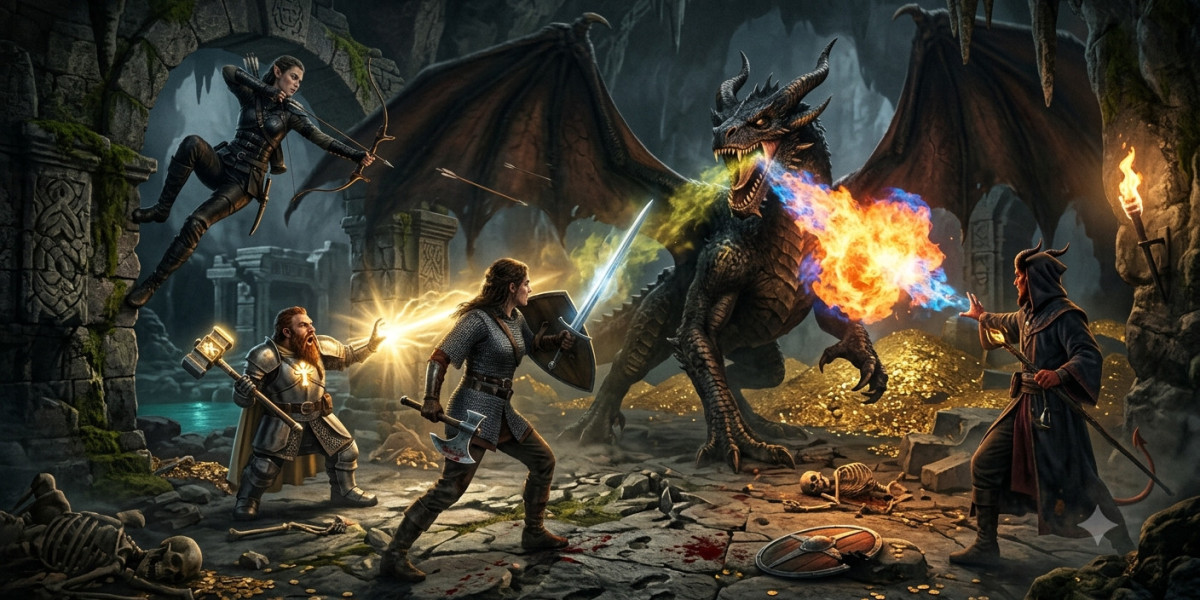
Building a fair, exciting combat encounter is one of the trickiest parts of running a Dungeons & Dragons 5th Edition campaign. Too easy, and your players get bored. Too hard, and a beloved character might end up dead before the story even gets going. That's where a D&D 5e Encounter Calculator becomes an essential part of every DM's toolkit. Instead of manually crunching challenge ratings, monster math, and party level D&D 5e Encounter Calculator scaling, you can use a free online to instantly generate balanced encounters tailored to your group's size and level, saving hours of prep time before every session.
What Is a D&D 5e Encounter Calculator and Why Do DMs Need One?
How does the encounter calculator actually work?
The tool takes your party's size, average character level, and desired difficulty (easy, medium, hard, or deadly) and converts these inputs into an experience point (XP) budget. It then compares that budget against the XP values of monsters you want to include, factoring in multipliers for multiple enemies fighting together. This mirrors the official Dungeon Master's Guide encounter building rules, but does the math instantly instead of requiring you to flip through tables mid-session.
Why is manual encounter balancing so time consuming?
Calculating encounter difficulty by hand means adding up monster XP values, applying the correct multiplier based on how many creatures are in the fight, and cross-referencing that total against a per-character XP threshold table. For a party of five or six players facing a mixed group of monsters, this quickly becomes a multi-step process prone to small arithmetic errors that throw off the whole encounter's balance.
Also Check Out : Thecalculators
What problems arise from poorly balanced encounters?
An encounter that's too weak leaves players feeling like their choices don't matter, while one that's too strong can lead to unexpected character deaths, frustration, or a campaign derailing entirely. Consistently miscalculated encounters can also make spellcasters and martial classes feel over- or under-powered relative to the challenge, since resource management (spell slots, healing, cooldowns) depends heavily on how demanding a fight actually is.
Understanding Difficulty Thresholds and XP Budgets
What do "easy," "medium," "hard," and "deadly" actually mean?
Each difficulty tier represents a different percentage of risk for the party. Easy encounters test resource usage without real danger, medium encounters present a genuine but manageable challenge, hard encounters push characters toward tactical decision-making and possible resource depletion, and deadly encounters carry a real risk of character death if handled carelessly. The calculator assigns XP thresholds per character level for each of these tiers, then sums them for the whole party.
How does party size affect the XP budget?
A party of four characters has a very different XP budget than a party of six. Rather than simply multiplying by headcount, the calculator accounts for the fact that larger parties can typically absorb more simultaneous threats, while smaller parties are more vulnerable to being overwhelmed by multiple enemies acting on their turns. This nuance is often skipped when DMs calculate difficulty manually.
Why does the number of monsters change the effective difficulty?
Facing one powerful monster is fundamentally different from facing six weaker ones with the same total XP. The 5e rules apply an XP multiplier as monster count increases, since more enemies mean more actions per round, more opportunities to focus-fire a single character, and generally higher tactical complexity. The calculator automatically applies these multipliers so DMs don't have to memorize the exact multiplier table.
Practical Ways to Use the Calculator When Prepping a Session
Can I use this tool for homebrew monsters and custom stat blocks?
Yes, as long as you know or estimate the monster's XP value (often derived from its challenge rating), you can plug it into the calculator alongside official Monster Manual creatures. This is particularly useful for DMs running custom villains or reskinned monsters who still want mathematically balanced fights.
How do I plan encounters for an uneven party level spread?
When players are at different levels, most calculators recommend using the average party level, then adjusting slightly upward if the group skews toward higher-level characters who can carry more of the combat load. Running the numbers with a slightly conservative average level tends to produce safer results.
Should I stack multiple weaker encounters instead of one big fight?
Many DMs use the calculator to test both approaches: one deadly boss fight, or two to three medium encounters spread across a dungeon crawl. Multiple smaller encounters can drain resources gradually, creating tension without a single high-risk spike, while a single big fight is easier to build a dramatic set-piece around.
Tips for Getting the Most Out of Your Encounter Planning
How often should I recalculate as my party levels up?
It's worth rerunning the numbers every time the party gains a level, since XP thresholds increase meaningfully between tiers of play. A fight that was deadly at level 3 might barely register as medium by level 6, so keeping your calculations current avoids accidentally under-challenging your players.
Does terrain or environment affect the calculator's output?
The base calculation focuses purely on XP math, but experienced DMs layer in environmental hazards, difficult terrain, or clever monster tactics on top of a "medium" encounter to effectively raise its real-world difficulty without changing the numbers. The calculator gives you the mathematical foundation; narrative and tactical elements add the rest.
Whether you're prepping a single one-shot or mapping out an entire campaign arc, a reliable D&D 5e Encounter Calculator takes the guesswork out of combat design so you can focus on storytelling and player experience. For this and dozens of other free planning tools, check out multiconverters.net, where you'll find calculators built specifically to make tabletop prep faster and more accurate.








fatimaparveenn 2 d
Building a fair, exciting combat encounter is one of the trickiest parts of running a Dungeons & Dragons 5th Edition campaign. Too easy, and your players get bored. Too hard, and a beloved character might end up dead before the story even gets going. That's where a D&D 5e Encounter Calculator becomes an essential part of every DM's toolkit. Instead of manually crunching challenge ratings, monster math, and party level scaling, you can use a free online D&D 5e Encounter Calculator to instantly generate balanced encounters tailored to your group's size and level, saving hours of prep time before every session.