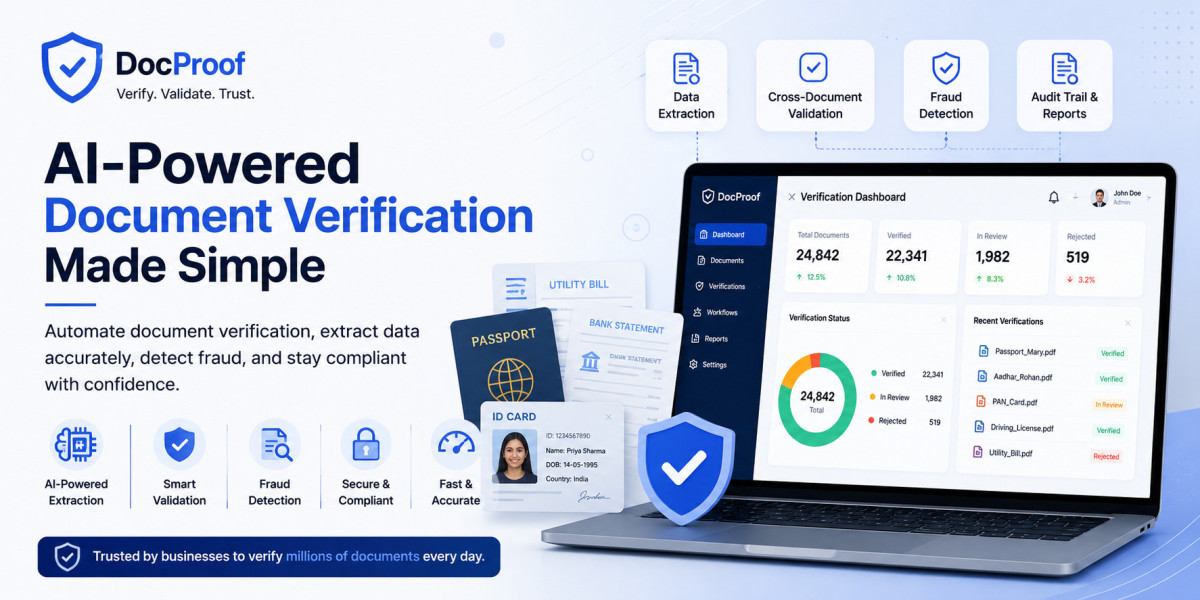
Every business verifies documents in some way. Whether it is onboarding a new customer, hiring an employee, processing a loan application, verifying vendor information, or completing KYC checks, documents play an important role in business operations. Companies collect identity cards, passports, driving licences, utility bills, tax documents, bank statements, certificates, and many other records before making important business decisions. While this process is necessary, verifying documents manually has become increasingly difficult. Employees spend hours reviewing documents one by one, comparing information across multiple files, checking for missing details, and communicating with customers whenever corrections are needed. As document volumes continue to grow, manual verification slows down operations and increases the chances of human error. This is exactly why businesses are adopting Document Verification Software. Instead of relying entirely on manual review, organizations can automate document collection, data extraction, validation, and verification while maintaining high accuracy. Modern AI-powered verification platforms help businesses process documents faster, improve compliance, reduce fraud, and create a better experience for both employees and customers.
What Is Document Verification Software?
Document Verification Software is a digital solution that automatically verifies business documents using predefined rules, Artificial Intelligence, and machine learning technologies. Rather than asking employees to manually inspect every document, the software extracts important information, validates it against business rules, identifies inconsistencies, and highlights exceptions that require human attention.
The software can verify many different types of documents, including identity cards, passports, driving licences, invoices, bank statements, educational certificates, utility bills, tax documents, business registrations, and many other records depending on the organization's requirements.
Instead of replacing employees, Document Verification Software reduces repetitive verification work so teams can focus on cases that genuinely require human judgement.
Why Manual Verification Is No Longer Practical
Manual document verification worked when businesses processed only a small number of applications every day. Today, organizations handle thousands of customer records, onboarding requests, compliance documents, and financial applications every month. Reviewing every document manually is not only slow but also inconsistent. Different employees may interpret documents differently, overlook small errors, or miss suspicious patterns that indicate fraud.
Another challenge is document inconsistency. A customer's name may appear slightly differently across multiple documents, addresses may not match exactly, or important fields may be missing altogether. Identifying these issues manually requires time and experience. As businesses grow, maintaining the same level of accuracy becomes almost impossible. Document Verification Software solves these challenges by applying the same validation rules to every document, ensuring consistency across the entire verification process.
How Document Verification Software Works
The verification process usually begins when documents are uploaded through a website, customer portal, mobile application, or internal business system. Once received, the software automatically extracts information from the documents using AI-powered document understanding and Optical Character Recognition (OCR).
After extraction, the system validates the information according to predefined business rules. It checks whether mandatory fields are present, compares information across multiple documents, identifies inconsistencies, detects duplicate submissions, and highlights suspicious patterns that may indicate fraudulent activity.
Instead of generating a simple pass or fail result, modern Document Verification Software provides detailed validation reports explaining why each verification succeeded or failed. This makes the entire process transparent and easier for business teams to review whenever required.
Key Benefits for Businesses
The biggest advantage of Document Verification Software is speed. Documents that previously required several minutes of manual review can now be processed within seconds. This allows businesses to onboard customers faster, approve applications more quickly, and reduce operational delays.
Accuracy also improves significantly because the software applies the same verification rules consistently across every document. Human errors caused by fatigue or inconsistent review standards are greatly reduced.
Another important benefit is improved compliance. Many industries must maintain proper verification records for audits and regulatory requirements. Automated verification creates detailed audit trails showing every validation performed, making compliance much easier to manage.
The software also improves customer experience. Customers receive quicker responses because verification happens almost immediately instead of waiting for manual review. Faster processing often results in higher customer satisfaction and reduced abandonment during onboarding.
AI Is Transforming Document Verification
Artificial Intelligence has changed document verification completely. Earlier systems focused mainly on OCR and basic field extraction. Today's AI-powered platforms understand document layouts, interpret context, validate relationships between multiple documents, and detect anomalies that would be difficult to identify manually.
Solutions like DocProof combine structured workflows with targeted Large Language Model (LLM) processing to automate document extraction and validation without relying on fully autonomous AI agents. This approach provides predictable costs, consistent outputs, easier debugging, and faster processing while allowing businesses to maintain complete control over verification rules.
Instead of reviewing every document manually, employees review only exceptional cases, making operations more efficient without sacrificing quality or compliance.
Who Should Use Document Verification Software?
Almost every industry that handles customer documents can benefit from Document Verification Software. Banks use it for KYC verification, financial institutions process loan applications, insurance companies verify policy documents, healthcare organizations validate patient records, educational institutions verify certificates, HR departments confirm employee documentation, and enterprise organizations automate supplier onboarding.
Any business that processes large numbers of documents can improve speed, accuracy, and operational efficiency by automating document verification.
Conclusion
As businesses continue to grow, manual document verification becomes increasingly difficult to manage. Higher document volumes, stricter compliance requirements, and rising customer expectations require faster and more intelligent verification processes. Document Verification Software helps organizations automate document collection, extract critical information, validate data accurately, detect inconsistencies, and reduce fraud while maintaining complete transparency throughout the verification process.