
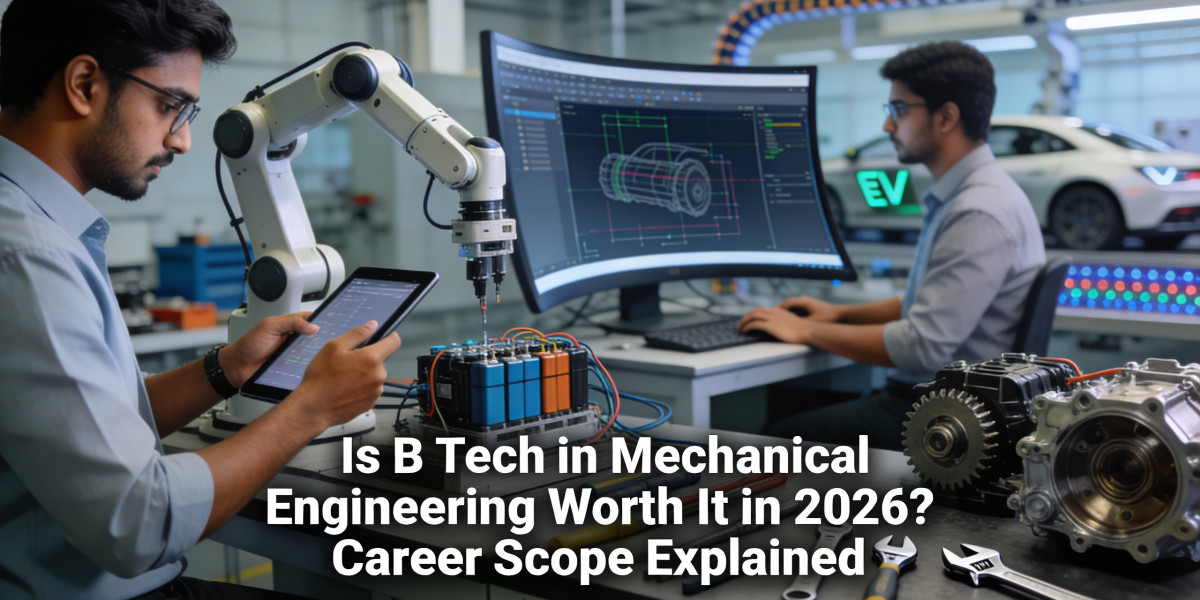
Choosing a career path feels heavier today than it did a decade ago. With AI and automation dominating every headline, you might wonder if traditional fields still hold their ground. If you are looking at a B Tech in mechanical engineering, you are likely asking if this "evergreen" branch still has enough juice to power a modern career.
Many students and parents worry that software is eating the world and leaving physical engineering behind. In this post, you will learn why that isn't the case. We will break down the current market trends, salary expectations, and the real-world mechanical engineering career scope to help you make an informed decision for your future.
Why Choose Mechanical Engineering Today?
The biggest myth right now is that mechanical engineering only deals with greasy gears and heavy engines. In reality, the field has merged with electronics and coding to create something much more exciting. When you ask why choose mechanical engineering, the answer lies in its versatility.
You aren't just learning to build machines; you are learning how to solve physical problems in a digital age. From robotics to renewable energy systems, the core principles you study stay relevant because the world will always need physical infrastructure.
It is one of the few fields where you can see your work come to life in a tangible way. Whether it’s a high-speed train or a life-saving medical device, your contribution has a physical presence that software alone cannot match.
Is Mechanical Engineering Worth It in 2026?
Let’s talk about the ROI. Is mechanical engineering worth it given the rising costs of education? In 2026, the answer is a resounding yes, but with a small catch. The value now lies in "Mechanical 2.0"—where you combine core mechanical skills with smart tech.
India is currently seeing a massive push in local manufacturing through the "Make in India" initiative. This has opened up thousands of roles in the electric vehicle (EV) sector and aerospace. Companies are looking for engineers who understand thermodynamics but can also work with sensors and data.
If you enjoy building things and want a job that offers stability along with a chance to work on green technology, this degree pays off. It offers a solid foundation that allows you to pivot into various high-tech industries later in your career.
Benefits of Mechanical Engineering and Career Scope
The benefits of mechanical engineering go beyond just a monthly paycheck. This degree teaches you a "builder’s mindset" that is highly valued in leadership roles. You develop a deep understanding of how things work from the ground up.
The mechanical engineering career scope is expanding into several new-age sectors:
Electric Vehicles: Designing battery cooling systems and lightweight frames.
Robotics & Automation: Creating the physical bodies and joints of industrial robots.
Renewable Energy: Managing wind turbines and solar thermal plants.
Aerospace: Developing parts for the growing private space industry in India.
Traditional roles in the public sector (PSUs) like coal, oil, and railways also remain steady options for those seeking long-term job security. The variety of paths available is truly unmatched by most other engineering branches.
Finding the Best University in Mumbai for Engineering
If you are based in or looking to move to Maharashtra, finding the right college is your next big step. Choosing the best university in Mumbai for engineering can significantly impact your placement opportunities. Mumbai is a hub for both industrial giants and tech startups.
Look for institutions that offer modern labs and partnerships with industries. A great university will give you hands-on experience with 3D printing, CNC machines, and simulation software. This practical exposure makes you "job-ready" the moment you graduate.
Proximity to industrial belts like Thane, Belapur, and Pune gives students in Mumbai a distinct advantage for internships. Make sure to check the placement records specifically for the mechanical branch, not just the overall college average.
Conclusion
A B Tech in mechanical engineering remains a powerhouse degree in 2026. While the tools have changed, the fundamental need for skilled professionals to design and maintain our physical world hasn't faded. By focusing on emerging tech like EVs and robotics, you can build a career that is both lucrative and future-proof.
If you have a passion for how things move and work, don't let the "tech-only" noise distract you. Mechanical engineering is evolving, not disappearing. Take the leap, pick a solid university, and start building the future.
Frequently Asked Questions
1. Does mechanical engineering require coding?
Yes, in 2026, basic coding is very helpful. You will likely use languages like Python or MATLAB for simulations and designing automated systems.
2. What is the average starting salary for a mechanical engineer in India?
Starting salaries usually range from ₹4 Lakh to ₹9 Lakh per annum, depending on your college and the industry. High-tech sectors like Aerospace often pay more.
3. Can I switch to software jobs after a B Tech in Mechanical?
Absolutely. Many mechanical graduates move into IT or Data Science because they possess strong analytical and problem-solving skills developed during their course.
4. Are there government job opportunities for mechanical engineers?
Yes, organizations like ISRO, DRDO, BARC, and various PSUs regularly hire mechanical engineers through exams like GATE or their own entrance tests.
5. Is mechanical engineering harder than other branches?
It involves a lot of physics and mathematics. If you enjoy those subjects, you will find it challenging but rewarding. It is more "hands-on" than most other branches.