
Executive Summary
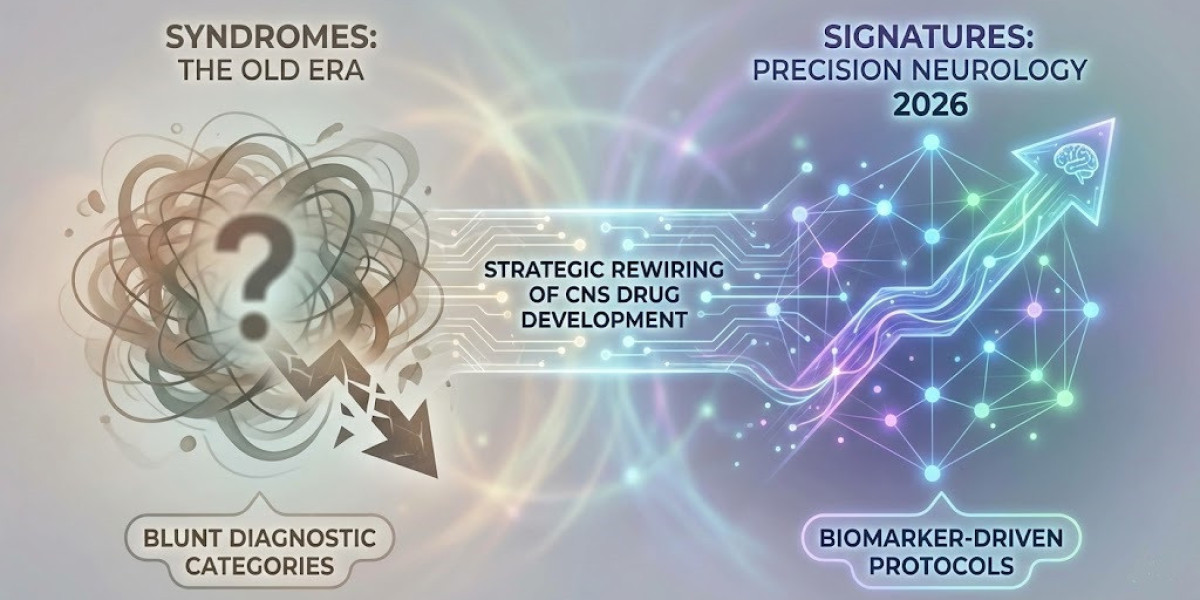
For much of modern neurology, diseases of the central nervous system were defined primarily by symptoms rather than biology. Diagnoses such as Alzheimer’s disease, major depressive disorder, and Parkinson’s disease represented broad clinical syndromesheterogeneous patient populations grouped together because underlying mechanisms were poorly understood.
That framework is rapidly being replaced.
Advances in molecular diagnostics, computational neuroscience, fluid biomarkers, and digital phenotyping are enabling CNS disorders to be reclassified according to biological signatures, neural circuit dysfunction, and measurable disease trajectories. Precision neurology is no longer a future concept; it is becoming the operational foundation of successful CNS development strategy.
This transition represents more than scientific evolution. It is a structural change in how therapies are discovered, developed, regulated, and commercialized. Programs built around generalized diagnostic categories and legacy trial models are increasingly vulnerable to failure, not necessarily because the underlying therapeutic mechanism lacks merit, but because the development architecture cannot resolve biological complexity.
Salience Clinical works at the intersection of neuroscience, translational medicine, regulatory strategy, and evidence generation helping biotechnology and pharmaceutical sponsors transform biological insight into executable clinical programs, differentiated regulatory positioning, and durable commercial value.
Target Audience:
Chief Medical Officers, Heads of R&D, Clinical Development Leaders, Translational Medicine Teams, and Biotechnology Executives focused on CNS innovation.
I. The Structural Problem in CNS Drug Development
Most CNS programs do not fail because the science is entirely wrong. They fail because heterogeneous patient populations dilute therapeutic signal beyond statistical detectability.
Traditional disease labels often encompass multiple biologically distinct conditions that present with overlapping symptoms. Treating these populations as uniform introduces enormous variability into clinical trials, particularly in disorders characterized by fluctuating symptoms, subjective endpoints, and high placebo response rates.
The Cost of Heterogeneity
- Late-stage CNS failures routinely consume hundreds of millions of dollars in development capital.
- Failure rates across several neuropsychiatric and neurodegenerative indications remain among the highest in biopharma.
- Statistical noise generated by poorly enriched populations frequently obscures otherwise meaningful biological effects.
In many cases, therapeutic mechanisms may be directionally correct, but the wrong patients are enrolled, the wrong endpoints are measured, or the biological hypothesis is insufficiently linked to clinical outcome.
The Emerging Precision Model
The strategic inversion now underway is straightforward:
Rather than starting with the syndrome and searching for biology, precision neurology starts with biology and defines the patient population around it.
This shift enables sponsors to:
- Reduce unnecessary enrollment
- Improve signal detection
- Lower placebo variability
- Increase regulatory credibility
- Build more defensible payer narratives
Precision enrollment strategies may substantially reduce trial size while improving statistical efficiency and development confidence.
II. Biological Reclassification: The Foundation of Precision CNS
The future of neurology will be organized around measurable biology rather than descriptive symptom clusters.
1. Fluid Biomarkers Are Redefining Disease Identification
Ultra-sensitive plasma biomarkers such as p-tau217, neurofilament light chain (NfL), and GFAP are changing the economics and scalability of CNS diagnostics.
Blood-based biomarkers offer several strategic advantages:
- Earlier disease detection
- Lower screening costs
- Improved patient enrichment
- Greater scalability compared with PET imaging or CSF sampling
Regulatory agencies increasingly recognize the role of biomarker-driven enrichment strategies in CNS development programs, particularly in neurodegenerative disease.
2. Target Engagement Is Now Essential
Demonstrating that a therapy reaches and modulates its intended CNS target has become a core regulatory expectation.
Sponsors are increasingly expected to establish a translational chain of evidence linking:
- Mechanism of action
- CNS exposure
- Target engagement
- Biomarker response
- Clinical relevance
PET imaging, pharmacodynamic CSF markers, electrophysiology, and advanced imaging approaches are now central to many successful translational strategies.
Programs that cannot demonstrate mechanistic clarity early often face escalating regulatory and investor risk later in development.
3. Biomarkers Must Support Regulatory Strategy
Scientific novelty alone is insufficient.
Biomarkers must be evaluated according to:
- Validation requirements
- Regulatory context of use
- Clinical relevance
- Operational scalability
- Potential payer acceptance
A biomarker that works well for exploratory stratification may not be suitable as a surrogate endpoint or companion diagnostic.
Precision strategy therefore requires alignment between biology, clinical development, diagnostics, and regulatory planning from the earliest stages of program design.
III. Engineering Signal in High-Noise CNS Systems
CNS disorders generate unusually high variability across clinical trials due to fluctuating symptoms, subjective scales, placebo effects, and inconsistent disease progression.
Modern precision programs focus on reducing noise as aggressively as they pursue efficacy.
Precision Enrollment
Advanced stratification approaches integrate:
- Genomic information
- Baseline biomarker profiles
- Disease staging
- Behavioral signatures
- Cognitive trajectories
- Digital activity patterns
The goal is to identify patients most likely to demonstrate measurable biological and clinical response.
Digital Phenotyping
Continuous digital monitoring is transforming endpoint sensitivity.
Passive and active data streams including speech analysis, motor activity, sleep patterns, cognition tracking, and behavioral monitoring allow sponsors to observe disease dynamics longitudinally rather than episodically.
Traditional clinic visits may capture a patient’s condition every several weeks. Digital phenotyping can capture disease behavior continuously.
This creates substantially greater temporal resolution and may reveal therapeutic effects that conventional scales fail to detect.
Reducing Placebo Response
High placebo response remains one of the largest operational threats in neuropsychiatric development.
Precision methodologies can help reduce variability through:
- Better site selection
- Improved patient characterization
- Real-time behavioral monitoring
- Objective biomarker integration
- Statistical enrichment strategies
The future of CNS development is not simply larger trials. It is smarter signal isolation.
IV. Regulatory and Commercial Co-Design
Precision neurology programs fail when scientific, regulatory, diagnostic, and commercial strategies evolve independently.
Successful programs integrate these functions from the outset.
Drug–Diagnostic Synchronization
If clinical success depends on biomarker-defined populations, companion diagnostic planning cannot be delayed until late-stage development.
Analytical validation, assay reproducibility, regulatory coordination, and commercialization planning must occur in parallel with therapeutic development.
Failure to synchronize therapeutic and diagnostic timelines can delay approval, complicate labeling, and weaken payer positioning.
Translating Biology Into Clinical Value
Biological sophistication must eventually translate into practical clinical utility.
Medical affairs and market access strategy increasingly require:
- Clinician-ready diagnostic frameworks
- Biomarker interpretation pathways
- Real-world evidence planning
- Health economic differentiation
- Clear patient selection logic
Payers and health technology assessment bodies are placing growing emphasis on identifying which patients benefit most, how durable those benefits are, and whether biomarker-guided approaches improve cost-effectiveness.
Precision medicine therefore becomes both a scientific and economic strategy.
V. Common Strategic Errors in Precision CNS Programs
| Strategic Misstep | Consequence |
|---|---|
| Selecting biomarkers without a regulatory roadmap | Increased validation burden and delayed timelines |
| Introducing precision strategy too late in development | Inability to restructure Phase II/III architecture effectively |
| Treating diagnostics as secondary workstreams | Regulatory misalignment and commercialization delays |
| Prioritizing scientific elegance over approvable claims | Weak differentiation and limited payer leverage |
| Relying solely on syndromic endpoints | Reduced sensitivity to biological effect |
VI. The Salience Clinical Model
Salience Clinical partners with biotechnology and pharmaceutical organizations to build precision-ready CNS programs from early translational planning through proof-of-concept execution.
Core Areas of Engagement
Strategic Advisory Partnerships
Longitudinal support across development strategy, biomarker architecture, regulatory positioning, and portfolio planning.
Translational & Biomarker Strategy
Designing integrated frameworks linking biological mechanism, target engagement, and clinical outcome.
Regulatory Development Planning
Supporting IND strategy, briefing documents, accelerated pathway evaluation, and precision-aligned endpoint planning.
Evidence & Commercial Alignment
Developing scientifically credible and commercially defensible evidence strategies for regulators, clinicians, payers, and investors.
VII. Why Precision CNS Requires Specialized Strategy
Large operational infrastructures are valuable for execution at scale, but precision neurology increasingly depends on high-level scientific integration and rapid strategic adaptation.
Successful precision programs require:
- Senior-level decision-making
- Cross-functional biological interpretation
- Fast translational feedback loops
- Integrated regulatory and commercial thinking
- Continuous adaptation as data emerges
In CNS development, strategic architecture often determines whether promising biology becomes an approved therapy or another late-stage failure.
Conclusion: The CNS Industry Beyond 2030
The transition from syndromic neurology to biologically defined neuroscience is already underway.
By the end of the decade, CNS disorders will increasingly be classified according to:
- Molecular signatures
- Circuit-level dysfunction
- Predictive biomarkers
- Digital behavioral profiles
- Disease progression trajectories
Clinical development models built for broad syndromic populations will become progressively less competitive in a precision-driven regulatory and payer environment.
The defining question for sponsors is no longer whether precision neurology will reshape CNS development.
The question is whether organizations will proactively architect for that future or be forced to react to it later at significantly greater cost.
About Salience Clinical
Salience Clinical, LLC is a strategic advisory firm focused on CNS development, translational neuroscience, regulatory strategy, and evidence architecture.
Led by Denis Katz, MD, MHA, the firm supports biotechnology and pharmaceutical sponsors in designing precision-oriented programs that align scientific rigor with regulatory credibility and long-term commercial viability.
Next Steps
Salience Clinical offers strategic program assessments focused on:
- Biomarker integration opportunities
- Translational risk reduction
- Regulatory acceleration pathways
- Precision enrollment architecture
- Clinical and commercial alignment
Contact:
Salience Clinical
Disclaimer
This material is provided for informational and strategic discussion purposes only and does not constitute medical, regulatory, legal, or investment advice. Regulatory approval outcomes are inherently uncertain and dependent on evolving scientific and agency standards.






