
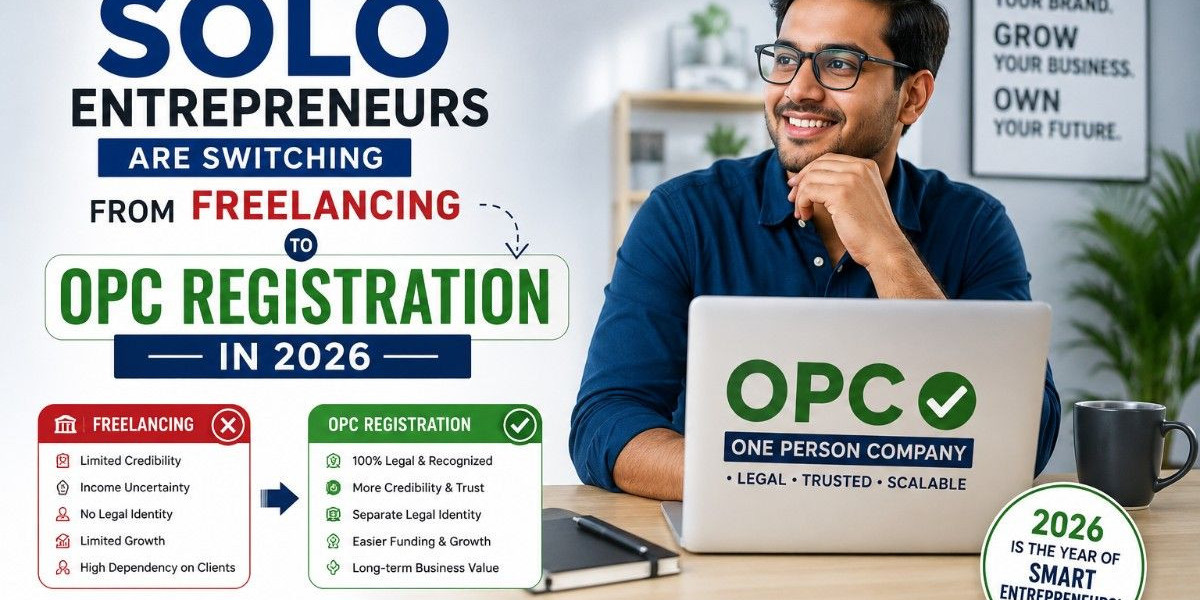
Why Solo Entrepreneurs Are Switching from Freelancing to OPC Registration in 2026
There's a quiet but unmistakable shift happening across India's startup landscape in 2026. Thousands of solo entrepreneurs, freelancers, consultants, independent coaches, and one-person agencies, are making a decisive move: they're choosing to register a One Person Company instead of continuing to operate as unregistered sole proprietors or informal freelancers.
If you've been wondering whether OPC Registration is right for you, or whether you should Register One Person Company to legitimize your solo venture, you're in the right place. This guide cuts through the noise and explains, from real business experience, why this shift is happening now, and what it means for you.
The Freelancing Problem Nobody Talks About
Freelancing offers freedom. But it also carries a hidden ceiling.
As a freelancer or unregistered sole proprietor, you are your business. Every contract is in your name. Every liability lands on you personally. Your bank account is your business account. When something goes wrong, a client dispute, a bad debt, or a tax complication, there's no legal firewall between you and the fallout.
Most solo entrepreneurs don't feel this weight until they try to grow. They approach a mid-sized corporate client and get asked for a company registration certificate. They try to open a business bank account and face friction. They want to raise a small round of funding or onboard an investor, and the structure simply doesn't support it.
This is exactly where One Person Company Registration changes the game.
What Is a One Person Company (OPC) ?
A One Person Company is a legal business structure introduced under the Companies Act, 2013, designed specifically for solo entrepreneurs in India. It allows a single individual to form a companym, with the limited liability protection typically associated with private limited companies, without needing a co-founder or multiple shareholders.
Think of it as the best of both worlds: the simplicity of running a solo venture, combined with the legal credibility and protection of a registered company.
Key features at a glance:
- Single promoter: Only one person can be the member and director
- Limited liability: Your personal assets are protected from business debts
- Separate legal identity: The company can own assets, enter contracts, and be sued independently
- Nominee requirement: You must appoint a nominee who takes over if you're incapacitated or deceased
- Conversion path: OPCs can convert to a private limited company once they grow beyond the threshold (annual turnover exceeding ₹2 crore or paid-up capital exceeding ₹50 lakh)
6 Real Reasons Solo Entrepreneurs Are Choosing OPC in 2026
1. Corporate Clients Now Demand It
This is the number one trigger. In 2025–2026, procurement policies at mid-to-large companies have tightened significantly. Vendor onboarding processes now routinely require a GST registration, a company incorporation certificate, and in many cases, an active business bank account in the company's name.
A freelancer operating under their own name simply doesn't clear these checks. An OPC does. If you're targeting B2B clients, especially tech companies, BFSI firms, or MNCs, OPC Registration is no longer optional; it's the admission ticket.
2. Limited Liability Is No Longer a "Nice to Have"
The economic volatility of the past few years has made risk management a top priority for small business owners. In a sole proprietorship, a single bad contract or legal dispute can put your savings, your home, and your assets at risk.
With an OPC, your liability is limited to the paid-up capital you've invested in the company. Business debts stay with the company, not with you personally. That protection is increasingly hard to put a price on.
3. Tax Efficiency Has Improved
Corporate tax rates for domestic companies under ₹400 crore turnover currently sit at 22% (plus surcharge and cess), while individual tax slabs can go up to 30%. More importantly, an OPC can legitimately claim business expenses, rent, equipment, professional development, travel, software, as deductible expenses in ways that are harder to substantiate under a sole proprietorship.
For solo entrepreneurs earning above ₹10–15 lakh annually, the tax math increasingly favors the OPC structure.
4. Easier Access to Business Banking and Credit
Banks treat registered companies differently. An OPC can open a current account in the company's name, apply for a business loan, access overdraft facilities, and in some cases, qualify for MSME-linked lending schemes that sole proprietors cannot access.
In 2026, with digital lending platforms now deeply integrated with MCA (Ministry of Corporate Affairs) data, having a live company registration instantly improves your credit access profile.
5. It Builds Long-Term Asset Value
A registered company has intrinsic value that a freelance practice does not. If you ever want to sell your business, bring in a co-founder, transfer intellectual property, or even wind down in an organized way, the OPC structure makes all of this significantly cleaner.
It also creates a paper trail, of revenue, of contracts, of tax filings, that builds a credible business history over time. That history matters when you eventually want to scale.
6. The Registration Process Has Gotten Easier
Three years ago, the paperwork and compliance burden of company registration put many solo entrepreneurs off. That friction has reduced substantially. Today, the One Person Company Registration process can be completed online via the MCA21 portal, typically within 7–10 working days with the right documentation in place.
A registered company secretary or a legal-tech platform can handle the entire process, name reservation (RUN), digital signature certificate (DSC), director identification number (DIN), SPICe+ filing, and issuance of the Certificate of Incorporation, for a reasonable professional fee.
Who Should Register a One Person Company?
OPC Registration is particularly well-suited for:
- Freelancers and consultants earning above ₹10 lakh annually who want liability protection and better client access
- Independent service providers (designers, developers, marketers, writers, coaches) building a personal brand backed by a legal entity
- Solo founders who want to validate a business idea before bringing on co-founders and converting to a private limited company
- Creative professionals who want to own intellectual property formally under a company rather than in their personal name
OPC is not ideal if you plan to raise institutional venture funding or have multiple co-founders from the outset in those cases, a private limited company is the right starting point.
OPC vs. Sole Proprietorship vs. Private Limited
Feature | Sole Proprietorship | OPC | Private Limited |
Minimum members | 1 | 1 | 2 |
Limited liability | No | Yes | Yes |
Separate legal entity | No | Yes | Yes |
Fundraising ability | Very limited | Limited | High |
Compliance burden | Low | Moderate | Higher |
Corporate client trust | Low | High | High |
Cost to register | Minimal | Moderate | Moderate–High |
What Does OPC Registration Actually Cost?
The total cost of One Person Company Registration in India in 2026 depends on professional fees and government charges, but typically falls in the range of ₹6,000 to ₹15,000 all-inclusive when done through a qualified CA or company secretary. Government filing fees are nominal; the bulk of the cost is professional service charges.
Annual compliance, including filing annual returns with the MCA, income tax return for the company, and maintaining statutory registers. adds an ongoing cost of approximately ₹10,000–₹25,000 per year depending on the service provider.
That's a modest investment relative to the legal protection, credibility, and business opportunity it unlocks.
The Compliance Reality
One common concern among solo entrepreneurs is the compliance burden of a registered company. It's legitimate, but also manageable.
An OPC must:
- Hold at least one board meeting every six months (with at least 14 days' notice)
- File annual financial statements (AOC-4) and annual return (MGT-7A) with the MCA
- Maintain statutory books and registers
- File income tax returns for the company
- Comply with GST requirements if turnover exceeds ₹20 lakh (₹10 lakh for special category states)
The good news: most of this is handled by your CA or company secretary. As the sole director, your primary job is to stay on top of key deadlines and ensure your accountant has what they need.
How to Register a One Person Company
- Obtain a Digital Signature Certificate (DSC) for the proposed director
- Apply for a Director Identification Number (DIN) through SPICe+ form
- Reserve your company name using the RUN (Reserve Unique Name) service on MCA21
- File SPICe+ (Simplified Proforma for Incorporating Company Electronically Plus) along with supporting documents: identity proof, address proof, registered office address, Memorandum of Association (MoA), and Articles of Association (AoA)
- Receive Certificate of Incorporation from the Registrar of Companies
- Apply for PAN and TAN in the company's name
- Open a business current account in the company's name
The process is sequential but straightforward with professional assistance.
Conclusion
The shift from freelancing to OPC Registration in 2026 isn't a trend driven by hype, it's a rational response to a changing business environment. Corporate clients want registered entities. Tax efficiency improves with structure. Liability protection matters more in uncertain times. And the registration process itself is now accessible enough that it no longer requires a large firm or a large budget to complete.
.






