
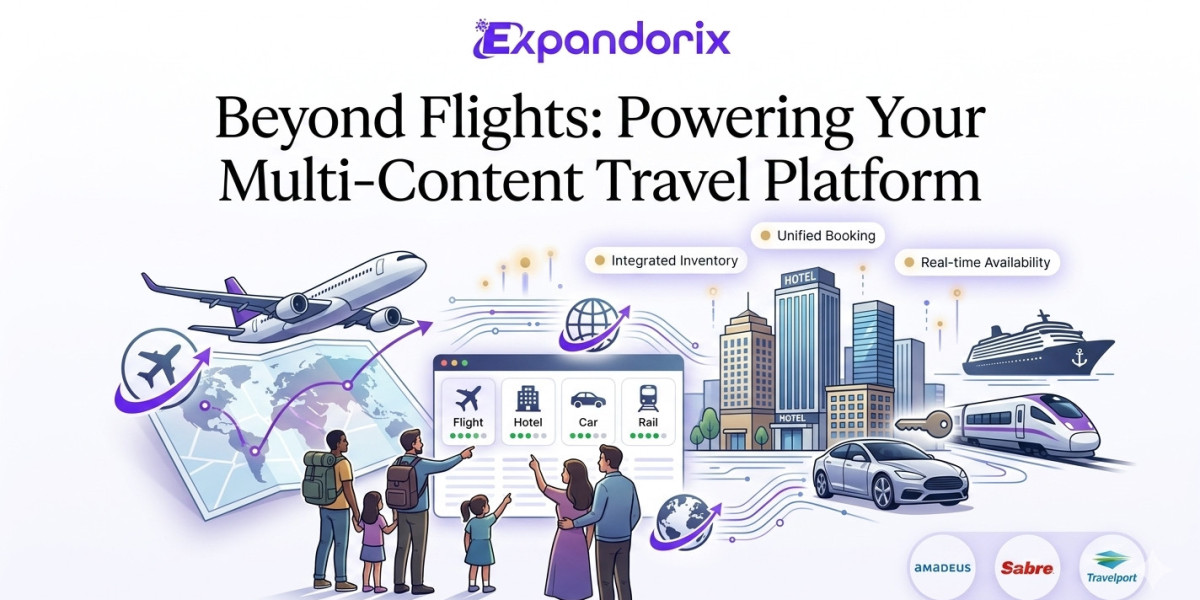
When most people think about GDS integration, they think about flights. And flights are indeed the most widely understood application of GDS technology. But the Global Distribution System is a comprehensive travel commerce infrastructure that distributes far more than airline seats. Hotels, car rentals, rail services, cruise lines, and even attraction tickets are all part of the GDS ecosystem.
For travel businesses that want to serve customers comprehensively — offering everything they need for a trip in a single platform — understanding and implementing multi-content GDS integration is essential. This article explores how GDS integration works for different travel product categories beyond air, what the technical and commercial considerations are, and how Expandorix builds the multi-content travel platforms that today's travelers expect.
Hotel Distribution Through GDS
Hotel content is the second-largest category in GDS distribution after air. The three major GDS providers collectively have connections to hundreds of thousands of hotel properties worldwide, ranging from global hotel chains to independent boutique properties.
How Hotel GDS Distribution Works
Hotels distribute their inventory through the GDS in one of two main ways: through the hotel chain's own Central Reservation System (CRS) connected to the GDS, or through a GDS representation service that aggregates independent hotels' inventory and loads it into the GDS networks.
When a traveler searches for hotels through a GDS-connected platform, the search query goes to the GDS, which queries its connected hotel CRS systems and returns availability and rate information. The response includes room types, rate plans, cancellation policies, and property descriptions.
Hotel GDS content includes:
- Chain hotels — All major global hotel brands (Marriott, Hilton, Hyatt, IHG, Accor, etc.) distribute through GDS. These are typically the most complete and reliable GDS hotel listings.
- Independent hotels — Many independent hotels connect to GDS networks through representation companies (sometimes called "third-party distributors" or "GDS hotel programs"). These include companies like Synxis, SHR, and others.
Bed and breakfast and boutique properties — Smaller properties increasingly use GDS representation services to gain global distribution.
Hotel GDS Integration Technical Considerations
Hotel GDS APIs return rich data about properties — room types, bed configurations, amenities, images, rate plans, cancellation policies, and more. Handling this data correctly in your booking platform requires a sophisticated hotel data model and display layer.
Key technical areas in hotel GDS integration:
- Rate Negotiation and Corporate Rates — Like airlines, hotels offer negotiated corporate rates through the GDS. Accessing these rates requires correct configuration of corporate account codes.
- Availability Search Optimization — Hotel availability searches can be slow if not properly optimized. Effective caching, asynchronous loading, and result pagination are important for user experience.
- Property Content Management — Hotel descriptions, images, and amenity data from the GDS may need to be supplemented with content from other sources (hotel content APIs, direct partnerships) for a rich display experience.
- Multi-Rate Display — Hotels often have many rate plans available for the same room type. Presenting these clearly without overwhelming customers requires careful UX design.
Expandorix's hotel GDS integration includes all of these capabilities, built on top of deep experience with hotel content from Amadeus, Sabre, and Travelport hotel programs.
Car Rental Distribution Through GDS
Car rental content is well-established in GDS networks. All major global car rental brands — Enterprise/National/Alamo, Hertz/Dollar/Thrifty, Avis/Budget, Sixt, Europcar, and others — distribute their inventory through the GDS.
How Car Rental GDS Distribution Works
Car rental availability is queried by pickup location (typically an airport code or city), pickup date and time, return location, and return date and time. The GDS queries connected car rental inventory systems and returns available vehicle categories with rates.
Car rental GDS content includes vehicle categories (economy, compact, intermediate, full-size, SUV, van, luxury), rate types (daily, weekly), included mileage terms, insurance options, and loyalty program integrations.
Car Rental Integration Considerations
Rate Transparency — Car rental pricing can be complex, with the base rate supplemented by taxes, fees, insurance charges, and optional add-ons. Presenting total cost of rental clearly is important for customer satisfaction.
- Location Data — Car rental pickup locations need to be clearly communicated, including terminal information at airports and address information for city locations.
- One-Way Rentals — Customers who want to pick up and return in different locations need one-way rental capabilities. These involve additional charges and availability constraints that the GDS handles.
- Corporate Rates — Like airlines and hotels, car rental companies offer negotiated corporate rates through the GDS for corporate travel programs.
Expandorix integrates car rental content as part of its comprehensive multi-content GDS integration offering, enabling clients to offer car rental booking seamlessly alongside flights and hotels.
Rail Distribution Through GDS
Rail travel is an increasingly important content category, particularly for European travel platforms where rail is a primary mode of inter-city travel, and increasingly for sustainable travel-focused platforms globally.
Rail Content in GDS
Amadeus has particularly strong European rail content through connections to operators like Eurostar, Thalys (now Eurostar International), Deutsche Bahn, SNCF, and Rail Europe. Sabre and Travelport also distribute some rail content, though Amadeus's European rail coverage is most comprehensive.
Rail GDS content typically includes:
Journey search — Point-to-point, with connection options. Fare classes — Different fare types with varying flexibility. Seat reservations — For trains where seat reservation is required or available. Passes — Some GDS-connected rail distributors also handle rail pass products.
Rail Integration Considerations
Rail booking flows are somewhat different from air booking flows. Train numbers replace flight numbers. Station codes replace airport codes. Seat reservation may be separate from ticket purchase. E-ticketing is common but not universal — some rail content still involves physical tickets.
Expandorix has experience integrating rail content for European travel platform clients, building booking flows that handle the specific characteristics of rail travel correctly.
Cruise Distribution Through GDS
Cruise line distribution through GDS is more limited than air, hotel, or car — most cruise bookings are made through cruise line websites or dedicated cruise specialist agencies rather than through GDS-connected booking platforms. However, GDS connections to major cruise lines do exist and are relevant for travel agencies that want to offer cruise alongside other travel products.
Sabre has the strongest cruise distribution capabilities among the major GDS providers, with connections to major cruise lines including Royal Caribbean, Carnival, Norwegian, and others. Cruise content in the GDS typically includes cabin availability, pricing by cabin category, and booking capabilities.
For travel platforms that serve a broader travel agency audience, adding cruise content through GDS connections is a valuable addition. Expandorix can integrate cruise content as part of a comprehensive agency platform build.
Building a Comprehensive Multi-Content Travel Platform
For travel platforms that want to serve as a one-stop shop for travelers — offering flights, hotels, car rentals, and optionally rail and other travel products — the technical challenge is building a unified booking experience across diverse content types.
Unified Search
A comprehensive travel platform ideally allows customers to search for all elements of their trip in one place. A "package" search that simultaneously queries GDS for flights, hotels, and car rentals requires parallel API calls, aggregation of results, and pricing logic for bundled packages. This is significantly more complex than single-content search but delivers a substantially better customer experience.
Package Pricing
Many travel platforms offer bundled packages — flight + hotel, flight + hotel + car — at attractive combined prices. Package pricing logic needs to handle the pricing of each component, calculate the total package price, and manage the booking of multiple components as a single transaction or as linked separate bookings.
Itinerary Management
When a customer books a flight, hotel, and car rental as part of a single trip, they need a single itinerary view that shows all elements of their trip. Building this unified itinerary experience — and keeping it updated when any component changes — requires sophisticated data management.
Cross-Sell and Upsell
A multi-content platform has natural opportunities to cross-sell. A customer who has just searched for a flight can be shown hotel options at their destination. A customer completing a hotel booking can be shown car rental options. These cross-sell flows increase average transaction value and improve customer experience by reducing the need to search separately.
Cancellation and Modification
Managing cancellations and modifications across multiple booking components is complex. A customer who needs to change their flight may also need to change their hotel and car rental. Handling these scenarios gracefully — with clear communication of policies and costs — requires careful design.
Expandorix's multi-content GDS integration framework is built with all of these considerations in mind. Clients get not just individual content integrations but a cohesive platform architecture that enables unified search, package booking, itinerary management, and intelligent cross-sell.
The Expandorix Advantage in Multi-Content Integration
What distinguishes Expandorix in multi-content GDS integration is not just the technical capability to connect to multiple GDS content types, but the experience and design thinking that makes multi-content platforms truly work.
Building a platform that connects to GDS for flights, hotels, and car rentals is relatively straightforward for an experienced integration team. Building a platform where the customer experience of searching for, combining, booking, and managing a complete trip is genuinely seamless — that requires deeper expertise.
Expandorix brings:
- Product design experience — Understanding of how customers want to experience multi-content search and booking, informed by working with many travel platforms.
- Architecture depth — The ability to design systems that handle the complexity of multi-content booking at scale without becoming a maintenance nightmare.
- Content quality focus — Attention to how content from different GDS sources is normalized, enriched, and presented to ensure a consistently high-quality display.
- Ongoing partnership — The ability to continue expanding content types and capabilities as the platform grows, with a team that already knows the codebase deeply.
Conclusion
GDS integration is far more than just flights. The GDS ecosystem offers access to comprehensive travel content — hotels, cars, rail, cruise — that enables travel platforms to serve customers end-to-end for their complete travel needs. Building on this comprehensive content base creates stickier platforms, higher average transaction values, and a genuine competitive advantage.
Expandorix is the GDS integration company that helps travel businesses realize this potential. With expertise across all content types and all major GDS providers, Expandorix builds the comprehensive, high-quality multi-content platforms that modern travelers expect and modern travel businesses need.
Whether you are starting with a single content type and planning to expand, or building a comprehensive platform from the ground up, Expandorix has the expertise and the approach to help you succeed.
*Build your comprehensive multi-content travel platform with Expandorix. Contact the team today for a free discovery consultation.*






